What is Halal Certification? And How Does It Open Global Export Markets and Raise Consumer Trust?
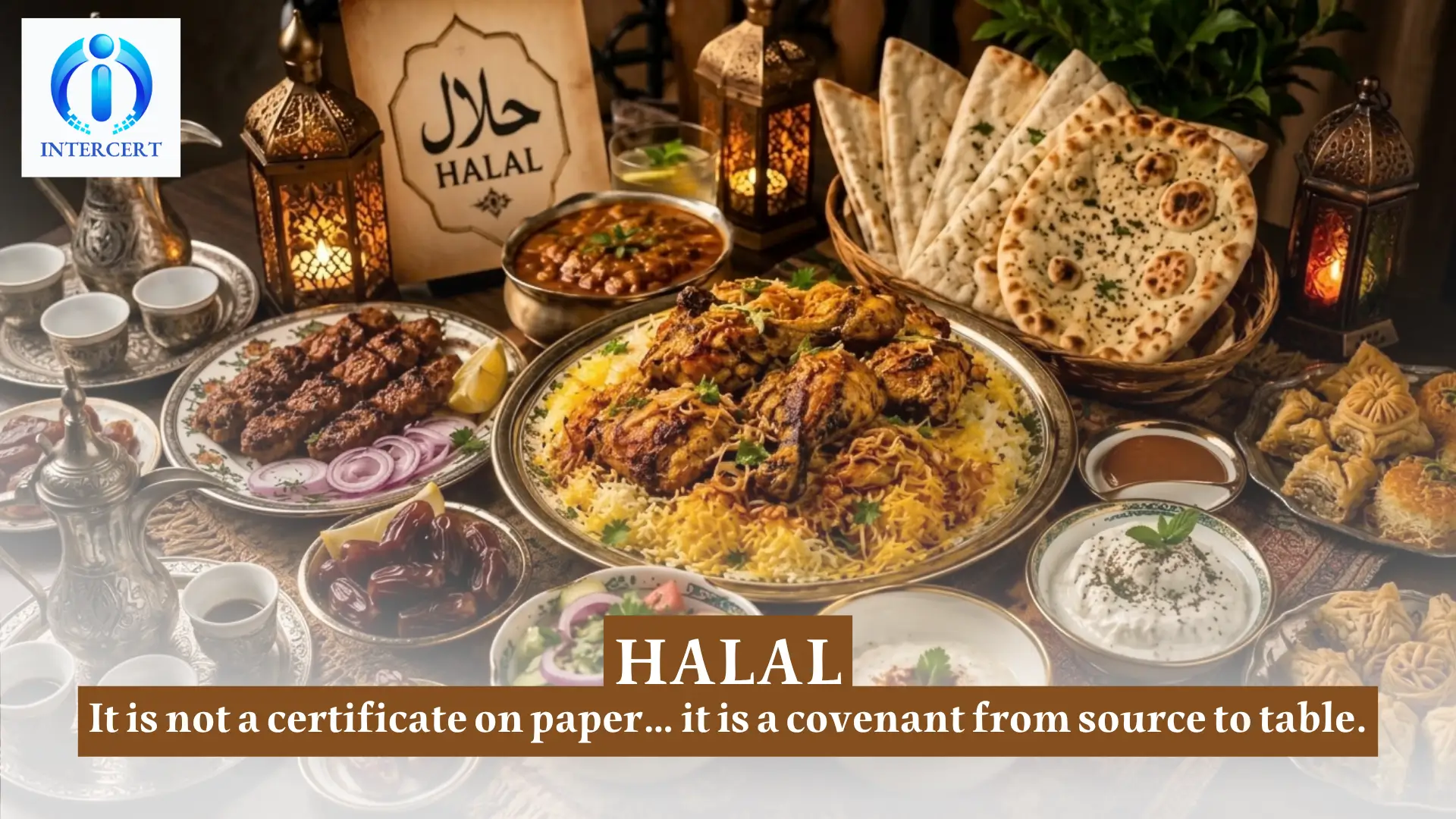
Your product may be Halal from the start: clean ingredients, separate production lines, and slaughter that complies with Sharia. But in global markets, it’s not enough to be Halal in your intention or in your practice—you must be documented and certified Halal. The difference between “Halal” and “certified Halal” is not a difference in essence but in the ability to prove it. And in international trade, what cannot be proven cannot be sold.
Here, Halal certification appears not as a religious slogan but as a traceability, safety, and quality system that links the farm, the factory, the supplier, and the consumer. It is not a stamp on the package but a complete chain of trust. This is why the global Halal food market reached approximately $2.71 trillion in 2024, with expectations of growth reaching $5.91 trillion by 2033. Numbers of this magnitude are not opened by prices alone, but by accreditation and trust.
The irony is that many Egyptian factories produce products that are perfectly suited for the Halal market, but they treat the certificate as a “formality” that can be postponed. The result: shipments rejected at ports, contracts lost, and entire markets remaining closed—not because the product is not Halal, but because proof of Halal does not exist.
And this is where Halal certification comes in—not as a certificate to hang on the wall, but as a roadmap that transforms your product from a mere local commodity into a product recognized in more than 50 Islamic countries and global markets that require Halal standards.
What is Halal Certification in Brief?
Halal certification is an official document issued by an accredited and credible conformity assessment body, through which it certifies that the products or services provided by the company meet the specified Halal standards and requirements according to the provisions of Islamic Sharia. Its fields include food industries, cosmetics, personal care, pharmaceuticals, and logistics services.
What Are the Most Notable Egyptian Achievements in Halal Certification?
Halal certification is no longer a luxury adopted only by large companies; it has become a standard of excellence adopted by leading institutions across various sectors in Egypt, driven by tangible economic benefits and national trends toward enhancing exports.
Strong signals from the Egyptian market confirm this strategic shift:
| Institution | Achievement | Significance |
| Sana Foods for Food Industries | Obtained Halal certification from the Egyptian Organization for Standardization and Quality (EOS) | Enhancing customer trust inside and outside Egypt and applying best practices |
| Juhayna Food Industries | 22 products bearing the Halal mark according to OIC/SMIIC 1:2019 and GSO 2055-1/2015 | Leadership of the dairy and juice sector in complying with international standards |
| Edita Food Industries | Shares classified as Halal according to AAOIFI methodology | Global financial recognition of the company’s products |
| Cairo Oils and Soap | Shares classified as Halal according to AAOIFI methodology | Extending Halal certification to include the financial sector |
| Agdawoodna for Food Industries | Obtained HALAL and NON-GMO certifications | Enhancing competitiveness in global markets |
| Al-Khams Nujoom for Food Industries | 13 food products bearing the Halal mark according to OIC/SMIIC | Expanding the portfolio of Halal-certified products |
| Bisco Misr, Obour Land, Beyti, Nile Sugar | Obtained Halal certification within a list of 205 companies | Diverse sectors joining the Halal system |
Halal Certification: Four Pillars That Transform Compliance into Competitive Advantage
| Pillar | Explanation | Tangible Result |
| Your Passport to Islamic Markets | Halal certification is a basic requirement for export to Islamic countries and the Organization of Islamic Cooperation. | Opening new markets and increasing exports to more than 50 countries |
| Consumer Protection and Trust Building | Ensuring the product is free from prohibited ingredients and compliant with Sharia | Trust of Muslim consumers, distributors, and regulatory bodies |
| Regulatory Compliance and Risk Avoidance | A requirement for importing meat and poultry in Egypt and many countries | Avoiding shipment rejection, port detention, and fines |
| Enhancing Global Reputation | A strong message reflecting commitment to Sharia standards and quality | Attracting global partners and improving the brand’s image |
Halal Certification: The International Standards on Which the System Is Based
| Standard | Body | Scope | Importance |
| OIC/SMIIC 1:2019 | Organization of Islamic Cooperation | General requirements for Halal food | The most internationally adopted standard for Halal food |
| GSO 2055-1/2015 | Gulf Cooperation Council Countries | General requirements for Halal | Required for export to Gulf countries |
| GSO 993:2015 | Gulf Cooperation Council Countries | Requirements for animal slaughter according to Islamic provisions | The basis for certifying meat and poultry |
| ES 4249/2023 | Egyptian Organization for Standardization and Quality | The Egyptian standard for Halal | The local framework governing certification issuance in Egypt |
The Accreditation Journey with INTERCERT—Halal That Begins with Understanding
| Stage | Practical Summary |
| Application and Scope Definition | Understanding your manufacturing activity, the products you produce, and the ingredients used |
| Supply Chain Review | Verifying the Halal status of all ingredients, suppliers, and production lines |
| Initial Review (Stage 1) | Review of Halal system documentation, policies, and procedures |
| Main Review (Stage 2) | Comprehensive on-site audit, record review, and verification of separation between Halal and non-Halal |
| Certification Issuance | Review of auditors’ report and issuance of internationally recognized certification |
| Follow-up and Sustainable Improvement | Annual periodic reviews and certificate updates when products or suppliers change |
How to Choose Your Trusted Partner in the Halal Certification Journey?
When choosing a certification body for Halal in Egypt, look for:
- Official Accreditation: Ensure the certification body is accredited by the National Accreditation Council (EGAC), the only body responsible for accrediting conformity assessment bodies in Egypt.
- Expertise in International Standards: A body that applies OIC/SMIIC, GSO 2055-1, and GSO 993 and understands the requirements of Islamic markets.
- Understanding of Local Regulations: A body that understands the requirements of the Egyptian Organization for Standardization and Quality and the Export and Import Control Authority.
- Proven Track Record in the Egyptian Market: A body with experience in the food, beverage, cosmetics, and pharmaceutical sectors.
- Impartiality and Independence: Certification decisions are made objectively and with complete integrity.
At INTERCERT, we bring together all these qualities. We are officially accredited by national and international bodies and have a proven track record of supporting Egyptian institutions in achieving compliance and global competitiveness.
Frequently Asked Questions About Halal Certification (FAQ)
What is Halal certification in brief?
Halal certification is an official document issued by an accredited conformity assessment body, certifying that the products or services meet the Halal standards and requirements according to the provisions of Islamic Sharia. It includes food and beverages, cosmetics, pharmaceuticals, and logistics services.
Who issues Halal certification in Egypt?
IS EG Halal is the body officially authorized by the Egyptian government to issue Halal certificates, in coordination with the General Organization for Veterinary Services and the General Organization for Export and Import Control. The government is also working to expand the number of issuing bodies to include the Ministry of Awqaf, the Ministry of Agriculture, and accredited private bodies.
What is the difference between OIC/SMIIC, GSO 2055-1, and ES 4249?
- OIC/SMIIC is the international standard issued by the Organization of Islamic Cooperation and is the most globally adopted.
- GSO 2055-1 is the Gulf standard required for export to the Gulf Cooperation Council countries.
- ES 4249 is the Egyptian standard issued by the Egyptian Organization for Standardization and Quality and is used as a local framework for issuing certificates in Egypt.
Is Halal certification mandatory in Egypt?
Halal certification is mandatory for importing meat, poultry, and their products, as the Ministry of Agriculture requires that shipments be accompanied by a certificate issued by an approved Islamic body recognized by Dar Al-Ifta. As for dairy products, the mandatory Halal certificate for them was canceled in March 2025.
How much does it cost to obtain Halal certification in Egypt?
The cost varies depending on the organization's size, number of products, complexity of the supply chain, and the readiness of the current quality system. We recommend contacting the INTERCERT team for an accurate quote.
How long does the certification journey take?
The duration varies depending on your organization's size and the readiness of your current system. Large organizations or those with complex systems may take longer.
Does the certification apply to all types of organizations?
Yes, Halal certification applies to all organizations regardless of size or sector, from food and beverage factories to cosmetics, pharmaceuticals, restaurants, hotels, and logistics services.
How does the certification affect export opportunities?
Halal certification is a basic requirement for export to Islamic countries and the Organization of Islamic Cooperation. The global Halal food market reached approximately $2.71 trillion in 2024, with expectations of growth reaching $5.91 trillion by 2033. Organizations holding the certification open new markets and maintain their products' competitiveness.
Does the certification help reduce risks and recalls?
Yes, through documentation, traceability, and supply chain verification, Halal certification contributes to reducing the risks of shipment rejection and product withdrawal and protects the organization's reputation.

Start Toward a More Trustworthy and Profitable Future
Halal certification is not just a certificate; it is an investment in your organization’s future, reputation, and ability to compete. With leading Egyptian examples like Sana Foods, Juhayna, and Edita, compliance with Halal standards has become a reality in the Egyptian market.
The numbers speak for themselves:
- Global Halal food market: $2.71 trillion in 2024
- Opening export markets to more than 50 Islamic countries
- Enhancing trust of consumers, distributors, and regulatory bodies
- Protecting the brand and reducing the risks of shipment rejection